


Living and learning in another country is a dream many people share. For some, studying abroad isn’t just about earning a degree or qualification — it’s an opportunity to broaden your horizons, discover new ways of thinking, develop language skills, and experience real independence in a way you’ve never tried before. For others, it’s also a pathway to building a new life in a new society.
But the moment people seriously start thinking about studying overseas, the worries begin: Where do I start? What do I need to prepare? What documents are required for applications and visas? Will it cost too much? And what if my English isn’t ready — do I still have a chance?
These feelings are completely normal. The process of studying abroad involves a lot of moving parts, and if you’ve never done it before, the preparation can seem quite complex.
The most important thing we want to tell you from the start: studying abroad isn’t only for “top students” — it’s for people who plan well. In this article, the i-study team will walk you through a clear Step-by-Step summary, from the very beginning all the way to just before departure, so that by the time you finish reading, you’ll know exactly what to do next — whether you’re just starting to research or already in the decision-making stage.
Why Study at a University Abroad? The Key Advantages
Before we get into preparation details, let’s take a moment to revisit why so many people want to study abroad. When you understand your own reasons clearly, your planning becomes far more focused and purposeful.
The first benefit everyone talks about is a dramatic leap forward in English. Living in a country where English is the primary language is completely different from learning it in a classroom. You communicate in English every single day — ordering food, chatting with classmates, presenting assignments at university. After a while, you’ll notice the difference in your language ability yourself.
Beyond language, there’s the matter of internationally recognised qualifications. Degrees from leading universities in Australia, the UK, Canada, or the United States are respected by employers worldwide. In many industries, a foreign qualification is a clear and meaningful advantage — and often comes with access to better-paying job opportunities.
Another factor many people prioritise is career prospects. Today’s employers actively seek candidates with international experience, because it signals courage in the face of challenges, adaptability, and the ability to work across cultures. Some graduates go on to build careers in their study country entirely, as international demand for skilled graduates continues to grow.
Equally important, living independently teaches responsibility, time management, and problem-solving. Many people return home noticeably more confident. Studying abroad doesn’t just change your academic record — it changes how you think and how you carry yourself.

How to Prepare for Studying Abroad — A Complete Guide in One Article
When people think about the steps involved in studying abroad, they often jump straight to documents, visas, or choosing a university. But in reality, the most important starting point is planning in the right order — because when the sequence is right, everything that follows becomes much easier. This is especially true when you start preparing at least 6 to 12 months before your intended departure.
1. Identify Your Interests and Set Your Goals
The first step in studying abroad isn’t rushing to pick a country — it’s asking yourself clearly: What do I want to study, and why?
Start with some simple questions:
- What level do I want to study at — bachelor’s, master’s, PhD, diploma, or an English language course?
- Do I want to continue in my current field, or do I want to switch disciplines?
- After graduating, what do I want to do — come back and work at home, or try working abroad for a while?
- What is my budget, and when am I ready to go?
These questions matter enormously, because the answers will determine everything that follows: which country suits you, which universities to apply to, how much to prepare financially, and even which documents you’ll need. Without a clear goal, every plan that follows will be blurry too.
2. Choose the Right Country and University
Once you know what you want, the next step is choosing a country and university — the stage most people find both exciting and confusing. The truth is, there is no single “best” country for everyone. There is only the country that fits your goals, budget, and lifestyle.
Here’s a look at the highlights of the most popular destinations
- 🇦🇺 Australia — Home to 9 universities in the QS World Top 100 (2026). A safe and liveable environment. International students can work up to 48 hours per fortnight during semester. Ideal for students who want both academic quality and quality of life.
- 🇬🇧 United Kingdom (UK) — Home to some of the world’s oldest and most prestigious universities, including Oxford and Cambridge. Undergraduate and postgraduate degrees are shorter than in many countries (3 years for bachelor’s, 1 year for master’s). Student visa allows up to 20 hours of work per week during semester.
- 🇨🇦 Canada — Lower cost of living than the United States. An open and welcoming multicultural society. Strong pathway to Permanent Residency (PR) after graduation through the Post-Graduation Work Permit (PGWP).
- 🇳🇿 New Zealand — Friendly people, clear English accent, and lower living costs than Australia. Beautiful natural environment. Graduates can apply for PR after working in New Zealand for the required period. Suits students who prefer a calm, relaxed atmosphere.
- 🇸🇬 Singapore — Just a 2-hour flight away. Home to NUS and NTU, both ranked in the global Top 20. International partner universities offer bachelor’s programmes complete in 2 years and master’s in 1 year. Work opportunities are available after graduation. Perfect for students who want world-class education without travelling far.
Beyond university rankings, don’t overlook the city itself. Studying abroad isn’t only about what happens inside a classroom — it’s about daily life. Think of it like relocating your home. The climate, culture, safety, and post-graduation job opportunities all affect your happiness more than you might expect.

3. Plan Your Budget and Costs
Financial planning is something everyone has to deal with, and doing it clearly from the start is what makes the journey smooth.
One of the most common mistakes is looking only at tuition fees while forgetting about all the other costs of studying abroad. Here are some real figures:
Approximate Annual Tuition Fees:
- Australia: AUD 20,000–45,000 (ປະມານ 13,888–31,250 USD)
- United Kingdom: GBP 12,000–30,000
- Canada: CAD 20,000–40,000
Monthly Living Costs
As a rough guide, expect overall living costs of around 27,780–34,720 USD per month. If you choose Australia: Sydney starts at approximately AUD 2,200/month, Melbourne AUD 1,900/month, and Brisbane AUD 1,500/month. Singapore starts at approximately SGD 1,500/month.
One thing many people aren’t sure how to prepare for is the Financial Evidence (Bank Statement) requirement. Many countries require proof that you have sufficient funds for the entire duration of study when applying for a student visa. For example:
- Australia requires a minimum of AUD 2,500 per month (approximately 22,636 USD per year)
- New Zealand requires approximately 12.000 USDper year
- Singapore does not require a Bank Statement
Financial planning for studying abroad, therefore, isn’t just about having enough money to live on — it’s also tied to your visa documentation readiness.
Don’t forget to research scholarship opportunities alongside your planning. These include government scholarships, university scholarships, and awards from various organisations — such as Australia’s Endeavour Scholarships or the UK’s Chevening Scholarships. Some scholarships cover both tuition and living costs. University-based scholarships commonly cover 10–50% of tuition, which can significantly reduce the financial burden.
4. Prepare Your English Language Proficiency
Language is another major milestone in studying abroad, and it’s one area where you absolutely should not wait until the deadline is near before starting. The earlier you prepare, the more options you’ll have
The two most widely used English proficiency tests are:
- IELTS (International English Language Testing System) — widely accepted in Australia, UK, New Zealand, and Canada
- TOEFL iBT — particularly popular in the United States and Canada
Typical minimum IELTS score requirements:
- Bachelor’s degree: 6.0–6.5
- Master’s degree: 6.5–7.0
- Top-tier institutions such as Australia’s Group of Eight may require 7.0–7.5
TOEFL minimum scores are typically around 80–100 (out of 120).
Many people think they can wait and study closer to the exam date — but the reality is that the IELTS process involves much more than one test day. There’s practice time for reading, writing, speaking, the booking window, and waiting for results. If your first attempt doesn’t reach the required score, you’ll need to factor in time to re-sit. The recommendation is to start preparing at least 3 to 6 months before your actual IELTS sitting.
If your English isn’t quite there yet, that doesn’t mean you’re out of options. Many universities offer Pathway Programmes or Pre-sessional English courses where students can study English directly at the university first, then progress into their main programme — without needing to re-submit IELTS scores.

5.Prepare Your Key Application Documents
Document preparation is one of the most detail-demanding parts of the process. No matter how strong your profile is, incomplete or incorrectly submitted documents can cost you your place.
Academic Transcript — Must be an official English-language version, sealed and stamped by your institution (Official Sealed Transcript). Order this from the registrar’s office well in advance — some institutions take weeks. Many universities in Thailand now allow students to request this online.
Statement of Purpose (SOP) — One of the most critical documents. This is your opportunity to tell the university who you are, why you’ve chosen this programme, what your goals are, and how you intend to apply what you learn. A strong SOP doesn’t need complicated language — it needs to be clear and genuine.
Letter of Recommendation (LOR) — Usually 2–3 letters are required, from professors or supervisors who know you well. Contact them at least 1–2 months in advance to give them enough time to write something detailed and meaningful.
Depending on your field and level of study, you may also need: a degree certificate, a Portfolio (for creative disciplines), GMAT or GRE scores (for certain postgraduate programmes), or evidence of work experience (for some MBA programmes).
6.Applying for a Student Visa and Health Check
After receiving your Offer Letter from the university, many people feel relieved — but the student visa process is another step that requires significant attention. Each country has its own name and procedure: Australia uses the Student Visa (Subclass 500), while the UK issues a Student Visa.
Common documents required for a student visa application:
- Offer Letter or Confirmation of Enrolment (CoE) from the university
- A valid passport with sufficient remaining validity
- Financial evidence
- Health examination results and tuberculosis (TB) test (for some countries)
- Proof of accommodation
- Health insurance covering the full duration of study (e.g. OSHC for Australia)
One important warning: do not rely on outdated information or second-hand advice alone. Student visa rules can change at any time. Always verify requirements through the official government website of your destination country, or have a specialist — such as the i-study team — review your documents, including your SOP and personal statement, for accuracy and completeness. Incorrect information or missing documents can result in visa rejection, which then negatively impacts any future applications.
For countries that require an interview — such as the United States — visa officers aren’t looking for scripted answers. They want to see a logical, coherent plan: your reasons for studying, your financial arrangements, and your goals after graduation.
7.Finding Accommodation and Pre-Departure Preparation
Once your study plans and student visa are taking shape, don’t overlook the pre-departure period — this is the phase that determines whether your new life starts smoothly or stumbles at the beginning.
Main accommodation options:
- On-Campus (University) Accommodation — Convenient, close to classes, and ideal for first-year students to make new friends quickly. Spaces are limited, so apply early.
- Off-Campus Private Housing — Offers more flexibility and personal freedom.
- Homestay — Best for students who want to practise their language skills and absorb local culture from day one.
- Share House — A cost-effective option for students planning a longer stay.
Pre-departure checklist — don’t overlook these:
- Open a bank account in your destination country (some can be done online in advance)
- Get a local SIM card sorted
- Notify your home bank that you’ll be using your card abroad
- Learn some basics about the culture and social etiquette of your destination country
One final thing worth preparing is your mindset. Studying abroad isn’t all the beautiful moments you see on social media. In the early period, many students have to adjust to a new language, culture, learning style, and the occasional wave of homesickness. Mentally preparing yourself before departure will make a significant difference in how well you handle the adjustment.
Ready to Study Abroad? Let i-study Guide You Through Every Step
If you’ve read this far, you can see that studying abroad involves a lot of moving parts — from setting goals, choosing a country, budgeting, preparing your language skills and documents, to navigating your student visa and pre-departure logistics.
Some students prefer to manage everything independently, and that’s entirely possible. But it’s worth acknowledging that the process has a lot of detail — and some parts genuinely benefit from experienced guidance: knowing what to prioritise, what to watch out for, and what to prepare in advance.
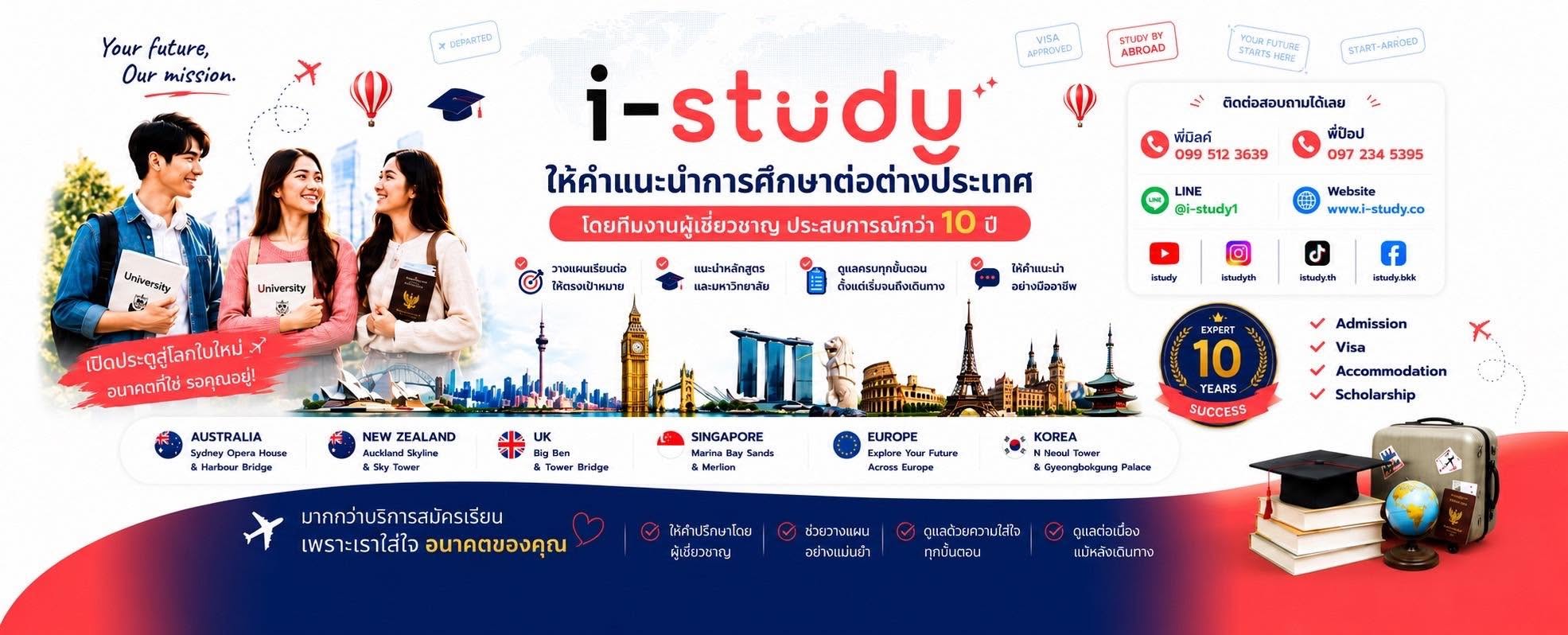
For help managing the documentation and the full process, the i-study team (www.i-study.co) is ready to support you at every stage — from a free initial consultation and needs analysis, to reviewing your SOP, LOR, and transcripts, handling your student visa application with care, and coordinating with institutions on your behalf throughout.
Having a team to help you organise your thinking and plan the sequence from the very beginning makes the whole picture much clearer, reduces stress, and saves both time and the cost of studying abroad in the long run — because a single wrong decision can sometimes lead to unnecessary extra expenses.
👉 Get a free consultation at www.i-study.co
📞Call: 099-512-3639
📱LINE: @i-study1
📲FB: istudy.bkk
📸IG: istudyth
If there’s one thing to take away from everything above: good preparation is the foundation of a successful study abroad experience.
Whether you’re just starting to explore the idea of studying abroad, or you already have a plan but want to make sure you’re on the right track — i-study is here to support and guide you at every step, from choosing where to study all the way to your departure day, and throughout your studies abroad.
Frequently Asked Questions (FAQ)
Q: How far in advance should I start preparing to study abroad? A: As a general rule, start at least 6–12 months ahead. The process involves many time-consuming stages: research, choosing a university, preparing documents, submitting applications, and applying for a student visa. If you also need to prepare for IELTS, starting early means you won’t feel overwhelmed later.
Q: My GPA isn’t high — can I still study abroad? A: Yes. Studying abroad isn’t measured by GPA alone. Many institutions consider a range of factors together — work experience, your SOP, language scores, and the clarity of your goals. In some cases, Foundation, Diploma, or Pre-Master programmes are available to help students build the required academic standard before entering their main programme.
Q: Why should I work with a study abroad agency like i-study? A: We have specialist knowledge and access to a wide range of options. We offer personalised consultations because we understand that every student has different needs and constraints. The preparation process has many details and multiple points where things can go wrong — especially around documentation, timelines, and the student visa. Having a team to help identify what to start first and what might be missing makes the whole process more structured and significantly reduces the risk of costly mistakes.
Q: My English isn’t strong, or I don’t have an IELTS score yet — can I still go abroad to study? A: Yes, in many cases. Some universities offer English language courses, Pathway programmes, or preparation programmes before the main degree starts. Once you pass the required standard (usually 60%), you can progress directly into the main course without submitting a new IELTS score. That said, if you already have plans to study abroad, start thinking about language preparation as early as possible — IELTS preparation and testing always takes time.
Q: Can I work part-time while studying abroad? A: Almost every country allows part-time work during study (Singapore and Thailand are notable exceptions), though conditions vary by country and visa type. Popular destinations like Australia, the UK, New Zealand, and Canada generally permit legal part-time work — typically around 10–25 hours per week during semester, with full-time work permitted during semester breaks. Always verify the latest rules through official government sources.
Q: I’m older or have been working for many years — can I still study abroad? A: Absolutely. It’s never too late to study abroad. If you have a clear goal and can articulate your reasons convincingly, many institutions actually view work experience as an asset — because you know what you want to study and how you intend to apply it. The key is to plan well and write an SOP that genuinely reflects your own goals and trajectory.
by i-study | www.i-study.co
แชทกับเรา!
เลือกวิธีติดต่อของคุณ
WhatsApp - ทีมงาน 👤 Human
คุยกับเจ้าหน้าที่จริง
WhatsApp - AI Bot 🤖 AI
ตอบอัตโนมัติ 24/7
LINE - ทีมงาน 👤 Human
คุยกับเจ้าหน้าที่จริง
LINE - AI Bot 🤖 AI
ตอบอัตโนมัติ 24/7
👤 เวลาทำการ: จ-ศ 9:00-17:00 น.
🤖 ตอบอัตโนมัติทันที ⚡